
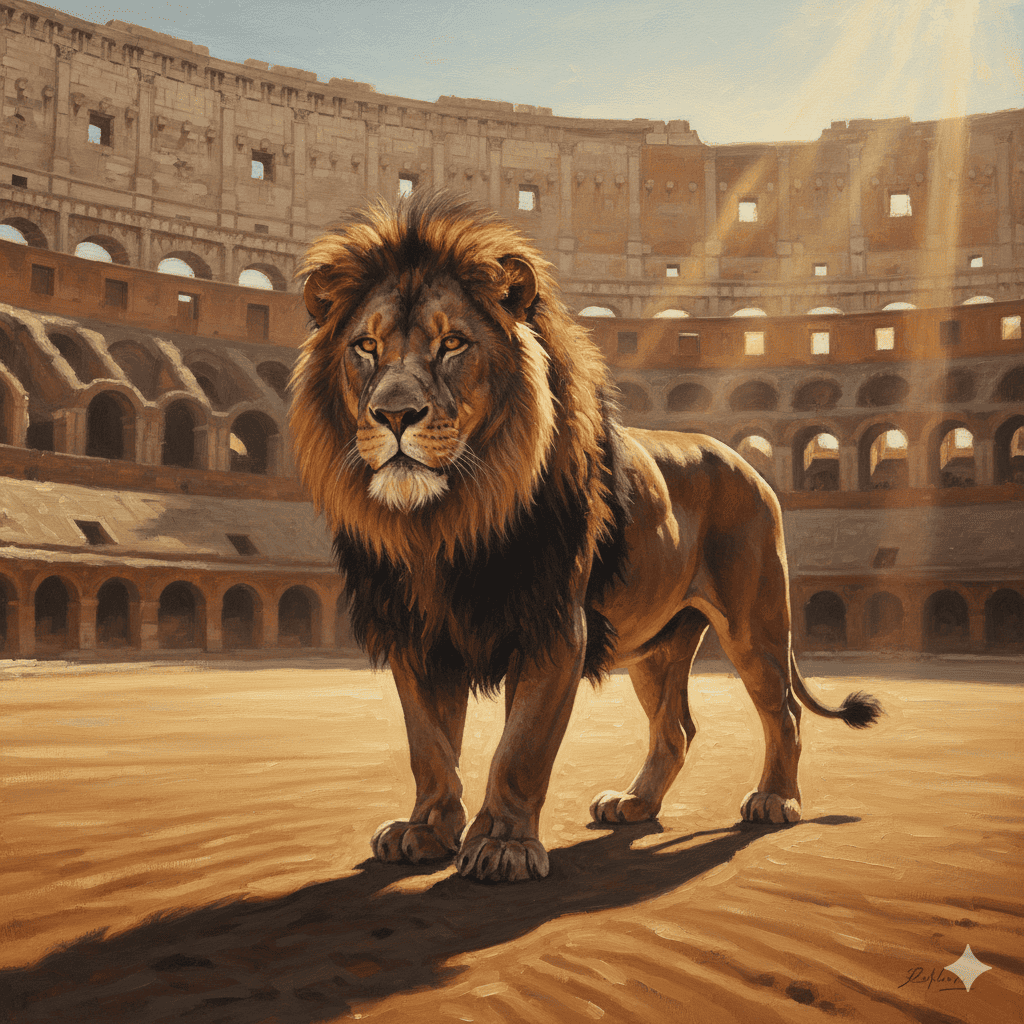
The Dust of the Colosseum

In the dark, the world was measured not by sight, but by vibration and scent. For Ignis, the transition from the vast, wind-swept ridges of the Atlas Mountains to the subterranean limestone labyrinth beneath Rome had been a slow death of the senses. Here, eighty feet below the Roman sun, the air was a stagnant slurry of damp straw, burnt oil, vinegar, human sweat, and the sharp, metallic tang of dried blood. It was a cage of echoes.
Above him, the earth groaned. It was a rhythmic, terrifying rumble—the synchronized stomping of fifty thousand sandals on wooden bleachers. Ignis lay on the damp stone floor of his narrow cage, his massive paws tucked beneath his chest. His black-tipped mane, once clean and thick from the mountain winds, was now matted with dust. Yet, his amber eyes remained clear, fixed on the wooden trapdoor overhead.
He remembered the cold. In the mountains of his youth, the air was sharp enough to sting the throat, smelling of cedar and wet granite. Hunting was a silent, cooperative dance of patience and sudden, explosive power. Here, there was no hunt. There was only the elevator.
The heavy iron gears of the hoist began to grind. Ignis felt the tension in his muscles coil instinctively. The wooden platform beneath his cage shook as ropes tautened, pulling the massive oak box upward into the vertical shaft. The darkness began to give way to a vertical strip of blinding, amber light. As the trapdoor parted, the silence of the underground was instantly shattered by a wall of sound so immense it felt like a physical blow.
The roar of the crowd was a chaotic, unnatural storm. Ignis stepped out of the wooden box and onto the hot, white sand of the arena floor. The midday sun heat hit his snout, carrying the scent of lavender oil and roasted meats from the luxury boxes, mixed with the sweat of the lower tiers. He squinted, his pupils contracting to thin black slits in the blinding glare of the afternoon.
The walls of the amphitheater rose like a stone mountain around him, packed with a sea of moving colors. In the center box sat the Emperor, draped in purple silk, flanked by silent Praetorian guards. But Ignis did not look at the Emperor. His attention was locked on the far side of the arena.
A gate slid open. A man stepped out.
The man was a murmillo, a gladiator of the arena. He carried a heavy rectangular shield and a short sword, his face entirely concealed behind a bronze helmet with a high crest. Ignis did not see a threat; he saw another captive. He could smell the man’s fear—it was a sour, cold scent that clung to his skin under the heavy leather armor. But beneath the fear, there was also a profound, heavy exhaustion. They had both been brought from far-away shores to die for the amusement of strangers.
The crowd bayed for blood, their voices rising in a unified chant. The gladiator raised his shield, taking a slow, defensive step forward, the sand crunching beneath his leather sandals. Ignis began to circle, keeping his body low to the ground. His instinct was to preserve his energy, to find an exit. He tested the perimeter, but the high stone walls were sheer, polished to prevent any escape, and lined with archers ready to strike down any beast that dared to leap toward the crowd.
There was no exit. There was only the sand.
The gladiator lunged, a calculated probe designed to draw a reaction from the crowd. The bronze sword flashed in the sun, grazing the air inches from Ignis’s snout. The crowd roared in approval. Ignis retreated a step, his tail twitching in the dust. He let out a low, vibrating growl that rattled the wooden barriers—not out of anger, but as a warning. He did not wish to fight this man.
But the arena allowed no room for mercy. The handlers at the edge of the sand brandished hot iron rods, pressing him forward. The gladiator advanced again, his breathing heavy and ragged inside his bronze helmet. The sword descended in a swift arc, slicing a shallow red line across Ignis’s shoulder. The pain was sudden and sharp, smelling of fresh copper.
Instinct, ancient and undeniable, took over. Ignis roared, a sound that silenced the stands for a fraction of a second, and charged. The weight of his five-hundred-pound frame slammed into the gladiator’s shield. Wood splintered. The force of the impact sent the man sprawling into the dust, his helmet rolling away to reveal a young, sweat-streaked face. The gladiator lay defenseless, his short sword lost in the sand.
The crowd rose to their feet, gesturing wildly, demanding the final blow. Ignis stood over the fallen young man, his chest heaving, his jaw dripping. He looked down into the gladiator’s eyes. There was no defiance left in them—only a quiet, resigned acceptance of the end.
Ignis paused. The instincts of the mountain, of the quiet cedar forests, returned to him. A true predator kills to eat, to protect, or to survive. He did not kill for sport, and he refused to be the instrument of another’s cruelty. He slowly backed away from the fallen gladiator, turning his back on the Emperor’s box, and walked toward the center of the sand.
The crowd’s roar turned into a confused, angry murmur. Ignis sat in the hot dust, his head held high, his amber eyes scanning the distant blue sky beyond the rim of the Colosseum. He let out one final, resonant roar—not a call of defeat, but a declaration of his own sovereignty. He would die here on the Roman sand, but he would die on his own terms, carrying the dignity of the Atlas Mountains intact.
As the archers at the rim raised their bows, the dust of the arena settled around him, golden in the fading afternoon light.
For those who find themselves moved by the quiet majesty and tragic dignity of the king of beasts, carrying a symbol of that strength is a natural expression. To explore our minimalist, premium tributes to these apex predators, browse the premium Lion Graphic Apparel at The Animal Republic, designed to capture the wild spirit in classic black and white.